
From the Founder’s desk, 15th Oct 2026.
KNOW THE BIOLOGY EARLIER
Rethinking Biologics Development Through Human Functional Evidence
A biologic can be molecularly well characterized—and still leave important biological questions unanswered.
Modern biologics are increasingly complex.
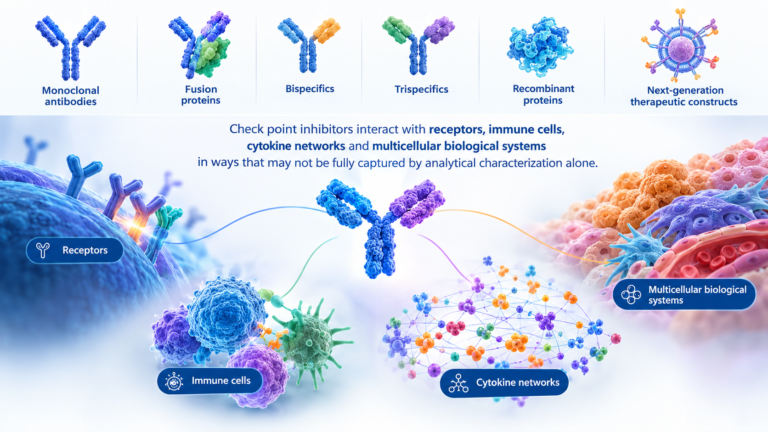
Monoclonal antibodies, fusion proteins, bispecifics, trispecifics, recombinant proteins and next-generation therapeutic constructs, check point inhibitors interact with receptors, immune cells, cytokine networks and multicellular biological systems in ways that may not be fully captured by analytical characterization alone.
Developers therefore face an important challenge:
How early can we understand what the molecule actually does in human biology?
Analytical methods can establish structure, purity, physicochemical properties and molecular attributes.
Traditional functional assays can confirm specific mechanisms.
But biological performance frequently emerges from interactions among multiple human cell types, pathways and signaling networks.
Understanding those interactions earlier may provide valuable insight into potency, safety, immunogenicity and translational behavior.
Moving from characterization to biological interpretation
The next generation of biologics development should increasingly connect:
Molecular identity
with
Human functional response
and ultimately with
Clinical relevance.
This means looking beyond a single endpoint.
For example, a biologic may influence:
- receptor activation;
- immune-cell behavior;
- cytokine release;
- cellular proliferation;
- pathway activation;
- tissue responses;
- inflammatory signaling;
- cell-cell communication; and
- concentration-response relationships.
Studying these signals together creates a richer representation of therapeutic biology.
Why this matters
Earlier human functional evidence can potentially help development teams answer questions such as:
Is the intended mechanism being activated?
How does potency compare with a reference molecule?
Are unexpected immune signals emerging?
Which concentration produces the optimal biological response?
Do different batches generate comparable functional effects?
Which biomarkers may later support clinical development?
The goal is not to generate more data.
The goal is to generate decision-relevant evidence.
DART for biologics
DART combines human cellular microphysiology with multimodal biological measurements and computational interpretation.
Depending on the development question, datasets may include:
- cytokines;
- cellular phenotypes;
- functional responses;
- transcriptomic signatures;
- imaging-derived biomarkers;
- pathway activation;
- dose-response relationships; and
- integrated potency scores.
Machine-learning models can then identify patterns that may not be apparent from individual endpoints alone.
From assay result to development intelligence
The traditional question:
“Did the assay pass?”
can evolve toward:
“What does the complete human biological response tell us about this molecule?”
That difference could become increasingly important as biologics become more complex.
The strategic opportunity
Biopharmaceutical companies that incorporate human functional evidence earlier may gain an opportunity to:
identify liabilities earlier, strengthen biological comparability, improve dose selection and increase confidence before clinical development.
DART Thought Leadership Question
For complex biologics, should potency remain a single assay result—or become an integrated measurement of human biological function?
Transcell Biologics | DART
Know the Biology Earlier.