
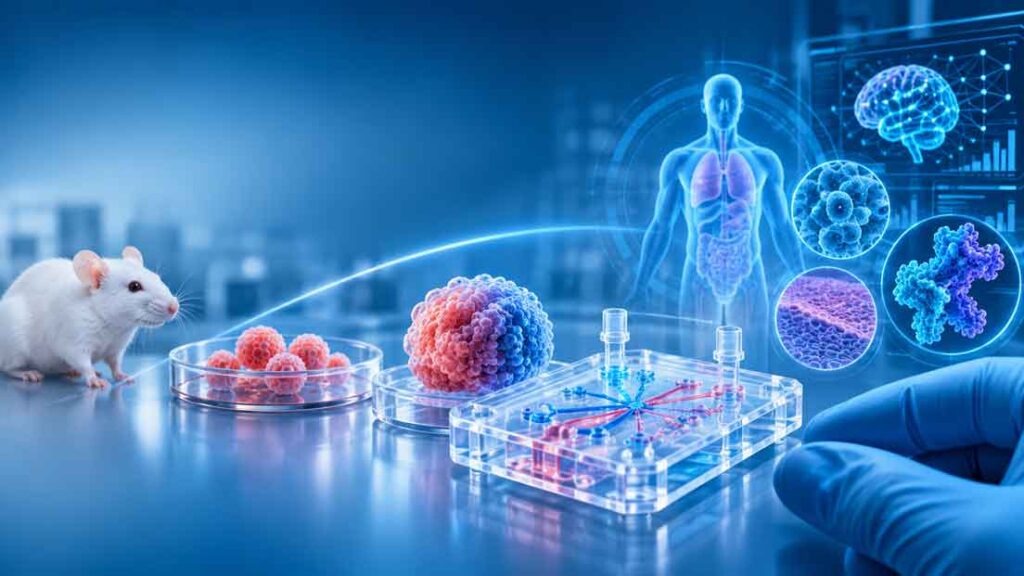
FDA's Evolving Approach to Nonclinical Testing: How NAMs Are Gradually Reshaping Drug Development
Introduction
Animal models continue to play a vital role in preclinical drug development, yet their translational limits are increasingly evident. Species-specific and induced disease models often fail to predict human responses, while critical toxicity signals may emerge only in later stages. Consequently, decisions built on non-human evidence carry mechanistic uncertainty across the pipeline.
The cost of that uncertainty presents themselves in the human trials, where the majority of drug candidates fail to reach approval. Between 2022 and 2026, the U.S. Food and Drug Administration (FDA) has steadily widened the methods sponsors can use alongside animal studies, from human-relevant microphysiologies to computational models. This article traces that shift and what it means for sponsors planning their nonclinical programmes.
Why FDA Nonclinical Testing Is Evolving: The Translational Gap
Clinical attrition has many causes, but one recurs across the pipeline: responses observed in animal models do not always translate to humans. Because species differ in how they process and respond to therapeutics, a drug candidate that appears safe and effective in preclinical studies can behave very differently in humans.
Human-relevant systems are designed to address this disconnect between preclinical results and human outcomes. Built on human-microphysiological systems, organoids and in silico models it reflects how human biology responds to a therapeutic, giving sponsors earlier and more relevant insight into efficacy and safety before a candidate reaches patients.
Five Regulatory Milestones Shaping FDA Nonclinical Testing (2022–2026)
FDA’s position has not changed through a single policy. It has shifted through a series of legislative, policy and guidance steps. 2022 – FDA Modernization Act 2.0 The Act removed the statutory requirement for animal testing before certain first-in-human studies, opening the door for sponsors to submit alternative nonclinical data where it is scientifically appropriate. It did not ban animal studies. It widened what FDA can accept in support of an application.
April 2025 – FDA Roadmap
FDA set out a phased plan to reduce animal testing in preclinical safety studies, starting with monoclonal antibodies, where species-specificity already limits conventional models.March 2026 – Draft NAM Guidance
Draft guidance proposed how FDA would evaluate New Approach Methodologies (NAMs): by context of use, relevance to human biology, technical characterisation and fitness for purpose.April 2026 – Year-One Progress Update
The year-one update reported progress on in vitro systems, computational approaches and weight-of-evidence strategies. It tracks implementation of the roadmap and adds no new requirements for sponsors.September 2026 – Nonclinical Testing Terminology Rule
A direct final rule replaces “animal testing” with “nonclinical testing” in FDA’s regulatory language, scheduled to take effect on 4 February 2027.What This Means for Sponsors
A broader evidence base
Human-relevant data from NAMs can provide additional evidence to support nonclinical safety and efficacy assessments when appropriately validated for their intended use.More informed decisions
Combining different nonclinical approaches can help sponsors better understand drug responses, identify potential safety concerns and make more informed decisions during drug development.FAQs
Has the FDA stopped requiring animal testing for drug development?
No. The FDA Modernization Act 2.0 removed the statutory requirement for animal testing before certain first-in-human studies and allows sponsors to use alternative nonclinical approaches where scientifically appropriate. It did not prohibit animal studies, which remain part of nonclinical testing.What are New Approach Methodologies (NAMs)?
NAMs are non-animal methods, such as organoids, human microphysiologies, organ-on-a-chip platforms, 3D tissue models, and in silico models, that can generate human-relevant evidence on drug response, efficacy, toxicity and ADME (absorption, distribution, metabolism, and excretion) when validated for a defined context of use.Why did FDA’s roadmap begin with monoclonal antibodies?
Many monoclonal antibodies bind human-specific targets, which limits the animal species in which they can be meaningfully tested. That makes conventional studies less predictive for this class and a logical place to start integrating human-relevant NAMs.References
- Sun D, Gao W, Hu H, Zhou S. Why 90% of clinical drug development fails and how to improve it? Acta Pharmaceutica Sinica B, 2022
- FDA: Roadmap to Reducing Animal Testing in Preclinical Safety Studies (April 2025)
- FDA: Reducing Animal Testing in Nonclinical Studies: Year One Progress and the Path Forward (April 2026)
- FDA: General Considerations for the Use of New Approach Methodologies in Drug Development (draft guidance, March 2026)
- Federal Register: Nonclinical Testing Terminology, Direct Final Rule (September 2026)