
Transcell Biologics is proud to be featured in Forbes India

“Transcell Biologics: Building India’s First Human Biology Intelligence Stack.”
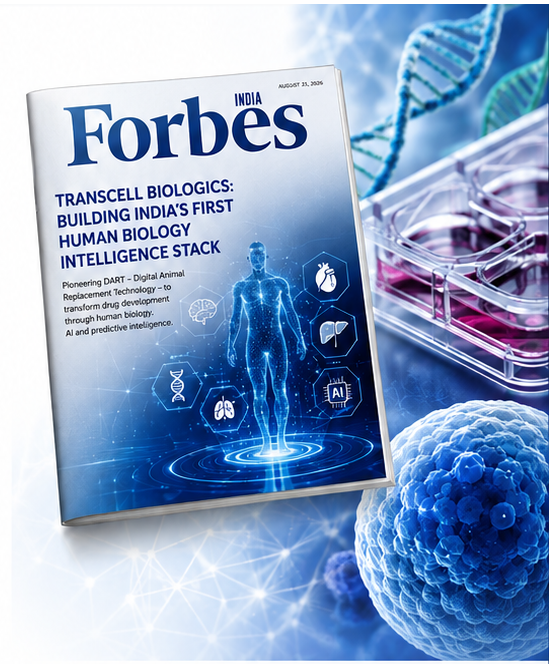
The feature captures an important shift at the heart of Transcell Biologics’s journey: moving drug development from an industry largely focused on discovering promising molecules toward one that can better understand and predict how human biology will respond to those molecules. At the centre of this vision is DART — Digital Animal Replacement Technology, Transcell Biologics’ human biology intelligence platform that brings together human MicroPhysiological Platforms, advanced biological measurements, computational biology and AI.


From Molecules to Human Predictability
One of the fundamental challenges in pharmaceutical R&D is not simply identifying molecules with therapeutic potential. It is determining, as early as possible, whether those molecules will demonstrate the required efficacy, safety, potency and biological behaviour in humans.

This gap between molecular discovery and human predictability is the problem Transcell Biologics is working to address.
Rather than treating preclinical testing as a sequence of isolated experiments, DART is being developed as an integrated and continuously learning infrastructure in which experimentally generated human biological response data can be transformed into predictive intelligence.

The objective is straightforward but ambitious:

Generate human-relevant evidence earlier → learn from every experiment → improve prediction → enable better drug-development decisions

Why DART Is More Than a Laboratory Platform

DART combines Transcell’s human MicroPhysiological Platforms with multimodal biological datasets and AI-enabled analytics to build an expanding understanding of human responses to drugs, biologics, vaccines and advanced therapies.

As more human-relevant experimental data are generated, the opportunity extends beyond replacing individual animal experiments. The larger goal is to create a Human Biology Intelligence Stack capable of supporting increasingly predictive decisions across the drug-development lifecycle.

This creates the foundation for applications spanning:

Safety • Efficacy • Potency • Immunogenicity • ADME/PK/PD • Translational Biology • Clinical Decision Support