
HUMAN BIOLOGY BEFORE HUMAN TRIALS
The Next Competitive Advantage in Drug Development
The industry does not have a data problem. It has a translation problem.
Drug discovery has become extraordinarily sophisticated. We can characterize molecules at atomic resolution, generate enormous omics datasets, engineer increasingly precise biologics, and apply AI across discovery pipelines.
Yet one fundamental uncertainty remains:
How will the therapy actually behave in the human body?
Traditional preclinical development has historically relied on a combination of transformed cell lines, simplified assays and animal models. These approaches have contributed enormously to biomedical science, but they cannot always reproduce the complexity of human tissues, human immune responses, patient heterogeneity or clinically relevant pharmacology.
The consequence is familiar across the industry: promising molecules fail late, unexpected toxicities emerge in humans, doses require recalibration, and biological effects seen preclinically do not always translate into clinical benefit.
A new question is emerging
The future of preclinical development may not be defined simply by asking:
“Does the molecule work in our model?”
The more important question is:
“How confidently does the model predict what will happen in humans?”
This is driving a transition toward human-relevant New Approach Methodologies—advanced in-vitro biology, Human MicroPhysiological Platforms, patient-derived systems, multimodal measurements and computational models capable of integrating complex biological signals.
The objective is not simply to replace one experimental model with another.
It is to build a more predictive human evidence layer before clinical exposure.
What this means for pharmaceutical R&D
Human-relevant development platforms can potentially strengthen decisions around:
- biological activity;
- mechanism of action;
- safety and toxicity;
- relative potency;
- immunogenicity;
- PK/PD relationships;
- dose selection;
- patient variability;
- translational biomarkers; and
- therapeutic response.
The value lies in making better decisions earlier, when changing a development strategy is still possible and relatively inexpensive.
Where DART fits
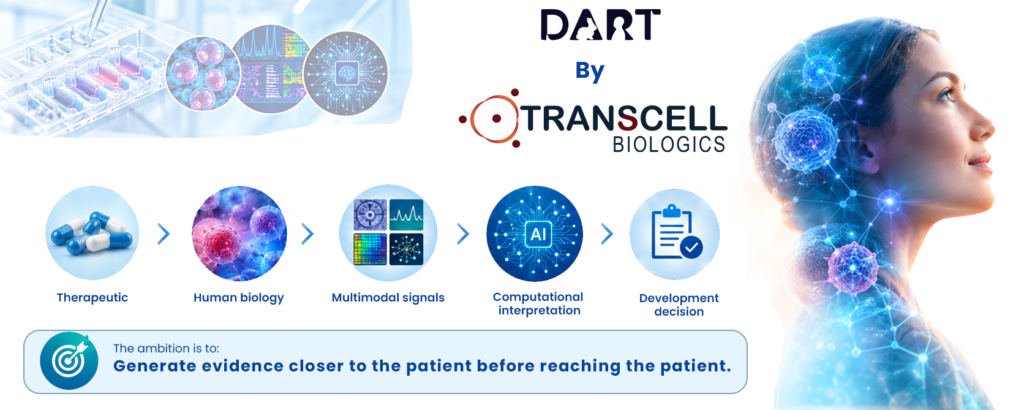
DART from Transcell Biologics integrates Human MicroPhysiological Platforms, multimodal biological measurements and AI/ML-driven interpretation.
Instead of producing another isolated assay endpoint, DART connects experimental human biology with the pharmaceutical decision being made.
Therapeutic → Human biology → Multimodal signals → Computational interpretation → Development decision
The ambition is to:
Generate evidence closer to the patient before reaching the patient.
The pharmaceutical industry is entering an era where human relevance will increasingly become as important as experimental reproducibility.
Organizations that build human biology earlier into development may not simply reduce animal dependence; they will make better medicines, faster and with greater confidence.
Thought Leadership Question
If the ultimate customer of every preclinical model is the human patient, shouldn’t human biology enter the development process much earlier?
Transcell Biologics | DART Human Biology Before Human Trials.